How Much Muscle Do You Lose on a GLP-1?
On a GLP-1, roughly a quarter of the weight you lose is lean mass, going by the best body composition data published so far. The SURMOUNT-1 DXA substudy scanned 160 adults at baseline and again at week 72, and about 75 percent of the weight lost was fat and 25 percent lean mass. That split held on tirzepatide and on placebo alike. It is the detail most scary headlines skip: tirzepatide did not invent a new kind of muscle loss, it produced much more weight loss, and weight loss has always taken some lean tissue along with it.
Semaglutide shows a similar shape. An exploratory DEXA analysis of 140 participants in the STEP 1 trial, presented at the Endocrine Society's 2021 meeting, reported a 19.3 percent reduction in total fat mass at week 68, with lean mass also falling. One caveat worth knowing. DXA lean mass is not the same thing as muscle, because it also counts water, organs and connective tissue, so these figures put an upper bound on muscle loss rather than measuring it directly.
Who Should Worry Most
Older adults and people who are already short on muscle carry the most risk on a GLP-1, simply because they have less to spare. The 2025 joint advisory on nutritional priorities for GLP-1 therapy, from the American College of Lifestyle Medicine, the American Society for Nutrition, the Obesity Medicine Association and The Obesity Society, names older age, perimenopause or menopause, lower testosterone, sedentary behavior and a lack of strength training as higher-risk factors.
The same advisory cites modeling suggesting that, without structured strength training, muscle can make up 10 to 15 percent of total weight reduction in women and 20 to 25 percent in men. A 35-year-old who already lifts twice a week and a 68-year-old who mostly sits are not having the same conversation, even on the same pen. If several of those risk factors describe you, raise muscle preservation with your prescriber before the first 20 pounds come off, not after.
Strength Training Is the Non-Negotiable Part
Resistance training is the most important thing you can do to protect muscle on a GLP-1, and walking is not a substitute for it. The joint advisory recommends regular strength training at least 3 times a week plus at least 150 minutes of moderate-intensity aerobic exercise weekly to preserve muscle and bone mass. Even the medication labels assume movement: the Wegovy prescribing information from Novo Nordisk indicates the drug in combination with a reduced calorie diet and increased physical activity.
You do not need a gym or a program with a Latin name. Sit-to-stand squats from a chair, push-ups against a kitchen counter, rows with a resistance band, carrying the heavy grocery bags on purpose. The Physical Activity Guidelines for Americans, published by the US Department of Health and Human Services, ask adults to work all major muscle groups on 2 or more days a week, and describe effective sets as ones taken to the point where another repetition would be hard without help. If you finish a set feeling like you could go all day, it was cardio.
Start lighter than your ego wants. Nausea, fatigue and eating less can all flatten your energy in the early weeks, which our GLP-1 side effects guide covers, so schedule sessions around your injection day rather than fighting through the worst of it. If you have heart disease, joint problems or balance issues, ask your clinician what is safe before you load a barbell.

Protein: What the Advisory Actually Recommends
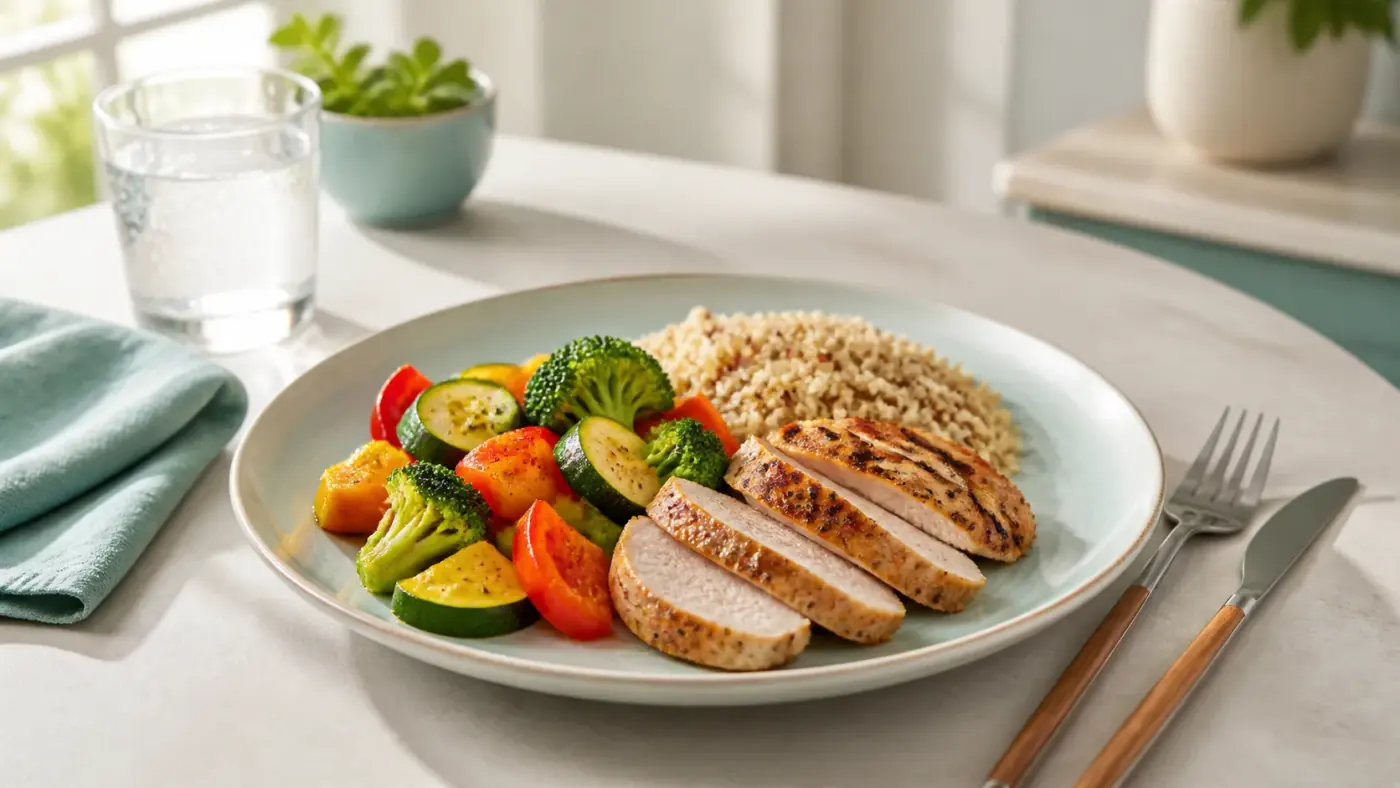
Protein needs go up, not down, while you are losing weight on a GLP-1, which is awkward because the drug makes you want less of everything. The 2025 joint advisory notes that targets of 1.2 to 1.6 grams per kilogram of body weight per day have been proposed during active weight reduction, and 1.2 to 1.7 g/kg during strength training. For people with obesity, the advisory frames protein needs against adjusted body weight, not current weight. That distinction matters. 1.6 g/kg of a 130 kg body is a target almost nobody on a GLP-1 could eat.
The advisory also sets a floor: protein intake in adults should not fall below 0.4 to 0.5 g/kg per day to avoid muscle atrophy. On a bad nausea week, slipping under that line is easier than it sounds. Eat the protein on your plate first, spread it across the day, and let your prescriber or a registered dietitian put a number on it for your body. Our guide to foods to avoid on GLP-1 medications covers how to fit protein in when your stomach is being difficult.
Muscle Protection Checklist
A muscle protection plan on a GLP-1 comes down to five things, and every target below comes from a named source you can check. Bring this table to your next appointment rather than guessing at the numbers yourself.
| What | Target | Source |
|---|---|---|
| Strength training | At least 3 sessions a week; never fewer than 2 days a week working all major muscle groups | 2025 joint advisory; Physical Activity Guidelines for Americans |
| Aerobic activity | At least 150 minutes of moderate-intensity exercise a week | 2025 joint advisory |
| Protein target | 1.2 to 1.6 g/kg/day proposed during active weight reduction, calculated on adjusted body weight if you have obesity | 2025 joint advisory |
| Protein floor | Never below 0.4 to 0.5 g/kg/day | 2025 joint advisory |
| Micronutrients | Ask whether vitamin D, calcium or B12 supplements make sense for you | 2025 joint advisory |
Targets are summarized from the published sources listed at the bottom of this page. Your prescriber or a registered dietitian should set the numbers that fit your health, weight and activity level.
What Does Not Work, or Is Still Unproven
Nothing sold as a GLP-1 muscle protector has better evidence behind it than lifting and eating enough protein, and much of it has no GLP-1 evidence at all. Creatine, collagen and branded "muscle-sparing" stacks get pushed hard online. We have not found them named as priorities in the joint advisory, which puts protein and strength training at the center, so that is where your effort should go first. ClinicalTrials.gov does list trials of experimental drugs aimed at protecting lean mass during semaglutide treatment. Experimental is the operative word.
Two more mistakes are worth naming. Cutting calories harder to speed things up tends to work against your muscle, not for it. And a slow scale is not proof the medication stopped working; building muscle while losing fat can flatten the number for a while, which our guide to weight loss plateaus on a GLP-1 explains. Track your waist, your strength and how your clothes fit, not only your weight. If you are thinking about coming off treatment altogether, read what the withdrawal trials found in our guide to stopping a GLP-1 and weight regain first, and talk it through with your prescriber.
Frequently Asked Questions
GLP-1 medications cause some lean mass loss because they cause a lot of weight loss, and weight loss nearly always takes some lean tissue with it. In the SURMOUNT-1 body composition substudy, published in Diabetes, Obesity and Metabolism in 2025, adults on tirzepatide lost a mean 33.9 percent of fat mass and 10.9 percent of lean mass over 72 weeks, and about 75 percent of the weight they lost was fat. DXA lean mass also counts water and organs, so it overstates muscle loss rather than understating it.
Protein targets on a GLP-1 are higher than the everyday allowance, and your prescriber or a registered dietitian should set your exact number. The 2025 joint advisory from the American College of Lifestyle Medicine, the American Society for Nutrition, the Obesity Medicine Association and The Obesity Society notes that 1.2 to 1.6 g per kilogram of body weight per day has been proposed during active weight reduction, and that people with obesity should calculate against adjusted body weight rather than current weight. It also says adult intake should not fall below 0.4 to 0.5 g/kg per day.
Strength training at least three times a week is what the 2025 joint advisory on GLP-1 nutrition recommends, alongside at least 150 minutes of moderate-intensity aerobic exercise weekly, to preserve muscle and bone. The Physical Activity Guidelines for Americans set a lower floor for all adults: muscle-strengthening work involving all major muscle groups on 2 or more days a week. If you have joint, heart or balance problems, ask your clinician what is safe before you start.
Muscle loss on a GLP-1 does not look proportionally worse than muscle loss from dieting, based on the best data published so far. In the SURMOUNT-1 DXA substudy, roughly 75 percent of the weight lost was fat and 25 percent lean mass in both the tirzepatide and placebo groups, and the placebo group was also following diet and activity advice. Tirzepatide produced far more weight loss, so the absolute amount of lean mass lost was larger, which is exactly why strength training and protein matter more on these drugs.
Want a Clinician to Plan for Your Muscle, Too?
Protecting lean mass is part of doing a GLP-1 well, and it belongs in the conversation with whoever prescribes it. Licensed online programs include clinicians who can review your risk factors, your side effects and your activity level, then help you set protein and exercise goals alongside your dose.
Prescription required. Medical screening and clinician review required. Not all patients will qualify. Affiliate disclosure: this site may earn a referral fee from programs listed.
Compare Online GLP-1 ProgramsSources
The following sources were used for the body composition data, exercise targets and nutrition guidance referenced on this page. Always verify against the most current version of each document.
- Look M et al. Body composition changes during weight reduction with tirzepatide in the SURMOUNT-1 study of adults with obesity or overweight. Diabetes, Obesity and Metabolism, 2025: DXA substudy of 160 participants; changes in body weight, fat mass and lean mass at week 72 of minus 21.3, minus 33.9 and minus 10.9 percent with tirzepatide, with about 75 percent of weight lost as fat and 25 percent as lean mass in both groups.
- Impact of Semaglutide on Body Composition in Adults With Overweight or Obesity: Exploratory Analysis of the STEP 1 Study. Journal of the Endocrine Society, 2021 (meeting abstract): DEXA subgroup of 140 participants, 19.3 percent reduction in total fat mass at week 68 with semaglutide 2.4 mg.
- Nutritional priorities to support GLP-1 therapy for obesity: a joint advisory from the American College of Lifestyle Medicine, the American Society for Nutrition, the Obesity Medicine Association and The Obesity Society, 2025: protein targets, protein floor, strength training at least 3 times weekly plus 150 minutes of aerobic exercise, higher-risk groups, and modeled muscle share of weight reduction.
- Physical Activity Guidelines for Americans, 2nd edition, US Department of Health and Human Services: muscle-strengthening activities involving all major muscle groups on 2 or more days a week.
- Wegovy (semaglutide) US Prescribing Information, Novo Nordisk: indicated in combination with a reduced calorie diet and increased physical activity.
- ClinicalTrials.gov registry listing of investigational studies on lean body mass during semaglutide therapy.